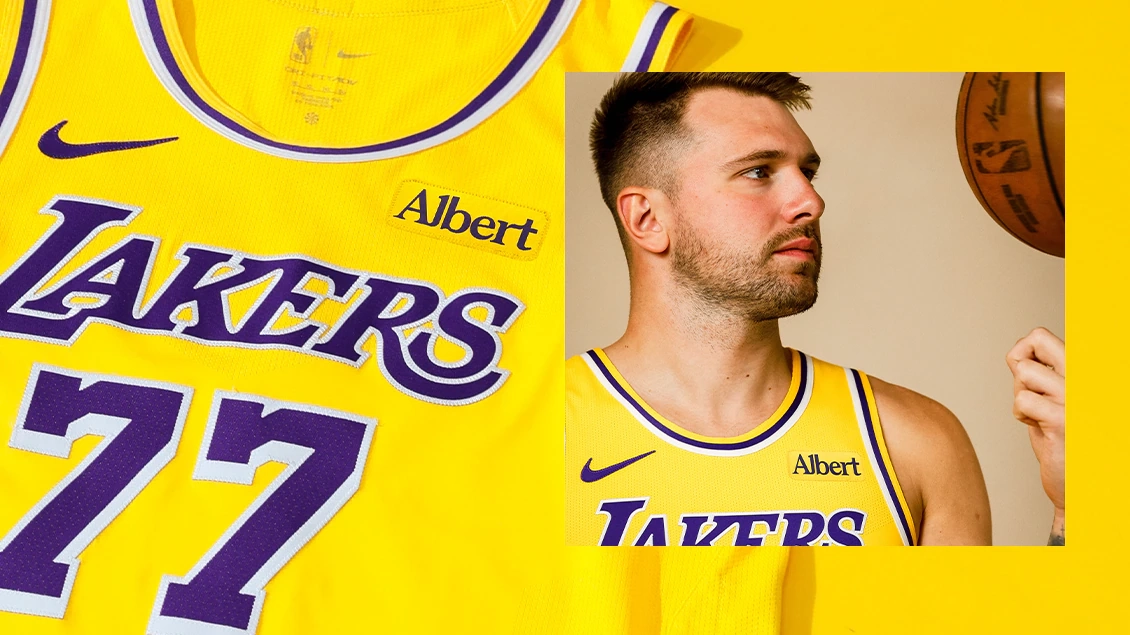
The Los Angeles Lakers have named Albert, a personal financial assistant app, as their new jersey patch sponsor in a deal reportedly worth more than $30 million annually, replacing Bibigo, the South Korean food brand whose patch has appeared on Lakers uniforms since 2021. The Albert logo will appear on the upper left chest of all four Lakers jersey designs beginning with the 2026-27 season.
Bibigos five-year, more-than-$100-million agreement, worth roughly $20 million a year, made it the first South Korean company to hold an NBA jersey patch and was explicitly built around expanding the brands footprint in the United States through one of the leagues most globally recognized franchises. That deals expiration after the 2025-26 season set up a competitive process for the patch, one of the most valuable pieces of sponsorship inventory in the NBA given the Lakers global following, and Alberts reported $30 million-plus figure represents roughly a 50 increase over what Bibigo paid, even before accounting for five years of league-wide media rights and franchise valuation growth since the original deal was signed.
The identity of the buyer is itself notable. Where Bibigo used the patch primarily as an international market-entry vehicle, Albert is a US-based financial technology company using the placement to build domestic brand recognition and consumer trust in a category, personal finance and banking apps, that has increasingly turned to marquee sports sponsorships as a credibility signal. Financial and fintech brands have become one of the most active categories in NBA jersey patch inventory over the past several sponsorship cycles, competing directly with the crypto, gaming and international consumer brands that dominated the categorys early years.
The price escalation matters beyond the Lakers own revenue line. Jersey patch deals are individually negotiated between each franchise and its sponsor, with no league-wide revenue sharing on patch inventory, meaning large-market teams like the Lakers effectively set the pricing ceiling that other franchises use as a comparable in their own negotiations. A confirmed jump from roughly $20 million to more than $30 million a year on one of the leagues most visible patches gives every other teams sales staff a stronger data point heading into their own renewal conversations, particularly for franchises whose existing patch deals are approaching expiration in the next one to two seasons.
For the wider industry, the deal reinforces that NBA jersey patch inventory, five seasons into the programs maturity, is still appreciating rather than plateauing, driven by rising franchise valuations, the leagues expanding global media reach, and now a broadening base of sponsor categories willing to pay premium rates for chest-level exposure on a global-market franchise. It also illustrates a shift in who is buying: fintech and consumer finance brands are emerging as the new frontier of patch spending, a category shift worth tracking as more marquee franchises approach their own patch renewal windows over the next two NBA offseasons.