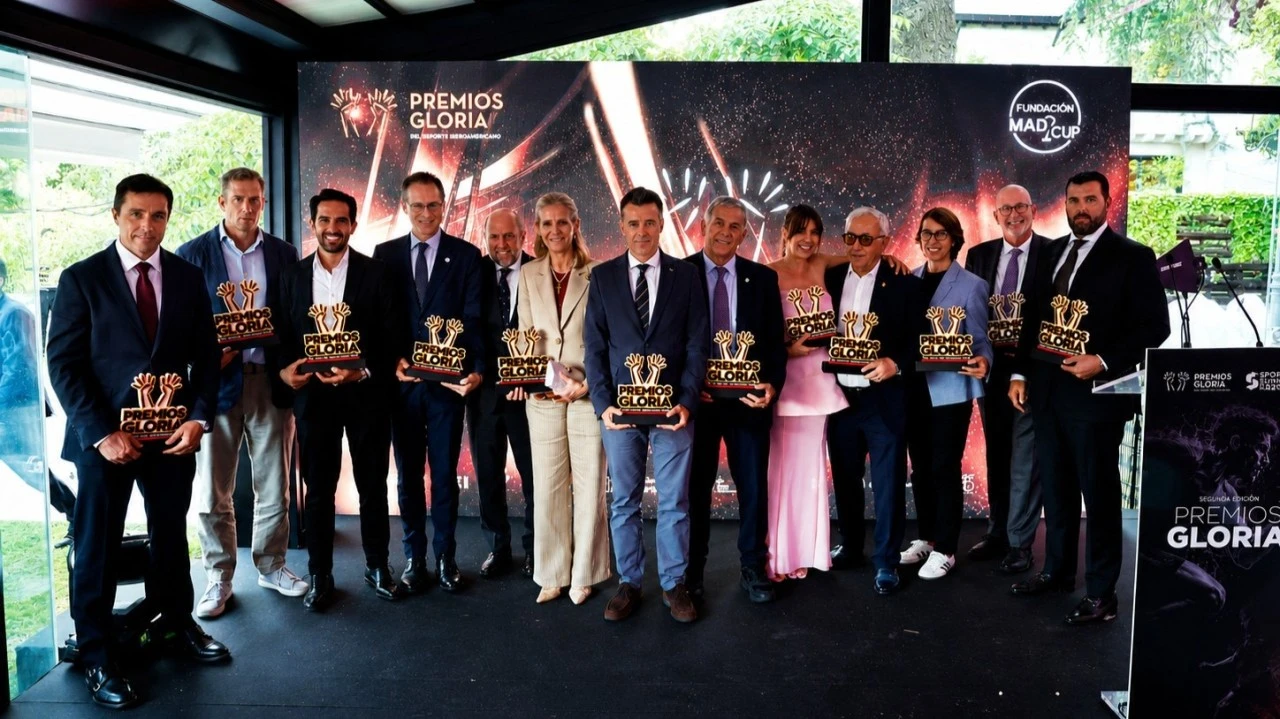
H.R.H. Infanta Elena, Fernando Belasteguín, Danys Báez and Alejandro Blanco headlined the second edition of the awards, further consolidating Madrid as a key meeting point for Ibero-American sport.
Madrid, June 18, 2026 – Madrid hosted this Wednesday the second edition of the GLORIA Awards for Ibero-American Sport, a ceremony that brought together some of the most prominent figures, institutions, and organizations from the international sports ecosystem to recognize those who, from different fields, contribute to elevating sport and expanding its impact on society.
Held at the MOM Culinary Institute במסגרת Sports Summit Madrid 2026, the awards celebrated outstanding careers and initiatives capable of generating real impact in areas such as perseverance, inclusion, innovation, sustainability, leadership, and sporting legacy.
Hosted by Cuban actress Laura Ramos, the ceremony opened with a tribute to sport as a force capable of uniting cultures, inspiring generations, and leaving a mark far beyond competition, setting the tone for a night that combined institutional recognition, international projection, and some of the biggest names in Ibero-American sport.
The first award of the evening went to the Alberto Contador Foundation, receiving the GLORIA Award for Inspiration and Overcoming Challenges in Sport. The Regional Minister for Culture, Tourism and Sport of the Community of Madrid, Mariano de Paco Serrano, presented the award to Alberto Contador, recognizing the foundation’s work in training young cyclists and promoting values such as effort, discipline, and resilience.
The former Spanish cyclist thanked the organization by highlighting the educational and social mission he has pursued through his foundation for over a decade:
“We started this project in 2011 thinking about giving back to society everything I was receiving at that moment. Cycling gave me values that are essential not only in sport, but in anything you dedicate yourself to. Values like perseverance, sacrifice, teamwork, getting back up after a fall… Thank you for this recognition, it truly means a lot to us.”
One of the central moments of the evening came with the GLORIA Award for Values and Sport, presented to Special Olympics. The President of Spain’s Higher Sports Council, José Manuel Rodríguez Uribes, presented the recognition to H.R.H. Infanta Elena and Miguel Sagarra, representing the organization. The presence of Infanta Elena highlighted the institutional significance of an award recognizing decades of work promoting inclusion for people with intellectual disabilities through sport.
During his remarks, Rodríguez Uribes emphasized the transformative role of sport and initiatives that foster social inclusion:
“There are victories that are not measured in medals, but in confidence, self-esteem, and the feeling of belonging to something deeply human. The organization we honor tonight has helped people with intellectual disabilities find their place to grow and thrive.”
Infanta Elena highlighted the growing visibility and development of inclusive sport over recent years:
“It is a privilege and an honor to give visibility to disability sport through our organization, Special Olympics. We are very proud of the work achieved so far, and we hope it continues growing even further in the future.”
The commitment to a more inclusive vision of elite sport continued with the GLORIA Award for Commitment to Inclusion and Diversity in Sport, presented to the International Paralympic Committee IPC. Luis Socias handed the award to Fernando Riaño, member of the IPC Governing Board, recognizing the institution’s decisive contribution to changing global perceptions of disability through sport.
Former Olympic gymnast Almudena Cid then received the GLORIA Award for Awareness, Education and Training in Sport, in recognition of her advocacy work and commitment to athletes’ emotional well-being and holistic development. The award was presented by Raquel Alía, President of the MADCUP Foundation.
In one of the evening’s most personal speeches, Almudena Cid reflected on the legacy sport leaves beyond competition:
“I retired from gymnastics 18 years ago and it still amazes me to continue being recognized. When you have been a role model in sport, you feel the responsibility to keep being one. Inspiring young people with the conviction that you can help change things has always motivated me. This award comes during a personally difficult week, and I needed a reminder that says: ‘Almu, you’re doing well.’ I’m especially grateful for the timing of this recognition.”
The ceremony continued by recognizing sport’s social and economic impact. Martín Lorenzo presented the GLORIA Award for Economic and Social Development of a Territory through Sporting Events to the Trinidad Alfonso Foundation, accepted by its General Director Juan Miguel Gómez, recognizing its decisive contribution to positioning the Valencian Community as one of Europe’s major sports hubs.
The GLORIA Award for Teamwork went to the River Plate Foundation, accepted by Secretary General Felipe Llorente, presented by Argentina’s Ambassador to Spain, Wenceslao Bunge Saravia, highlighting the social and educational impact of one of Latin America’s most influential sports institutions.
The Public Initiative for Sports Development Award recognized both Peru and Argentina. Fernando Cáceres presented the award to Sergio Ludeña, President of the Peruvian Sports Institute, while Sebastián Lateulade presented Argentina’s award to Diógenes de Urquiza, Argentina’s Undersecretary of Sports, highlighting the strategic role public policy plays in elite sports development.
Innovation and the future of the sports industry also played a major role. Miguel Ángel Benzal Alía and Javier Sotomayor presented the GLORIA Award for Transformative Initiative in Sport to WOW FC, accepted by Arturo Guillén. Later, José Ortiz and Belén Lara presented the GLORIA Award for Environmental Sustainability in Sport to the International Ski and Snowboard Federation FIS, accepted by May Peus.
The section dedicated to the future of sport concluded with the GLORIA Award for Innovation and Technology in Sport, presented to Amazon Web Services AWS. María Guadalupe Benzal Alía and Giba presented the recognition to Suzana Cusic, highlighting the growing role of technology, artificial intelligence, and advanced data analytics in the evolution of high-performance sport.
The final stretch of the ceremony was reserved for the evening’s most symbolic awards. Arantxa Sánchez Vicario presented the GLORIA Award for Ibero-American Sports Legend to Fernando Belasteguín, whose career — sixteen consecutive years as world number one and more than 230 titles — has made him one of the most influential figures in the history of padel and a driving force behind its global expansion.
Reflecting on a legendary career shortly after retirement, Belasteguín said:
“I played professional sport for 30 years, and now I enjoy everything I built. I was always obsessed with learning and improving, but there is still so much left to learn. Over this past year and a half since retiring, I’ve enjoyed the recognition, but most importantly, being able to look my family in the eye knowing I gave everything I had.”
Enrique Cerezo then presented the second award in this category to Danys Báez, former MLB All-Star pitcher, recognized for his historic Major League Baseball career and for becoming one of the most important Ibero-American sports figures in the United States.
Báez used his speech to emphasize that an athlete’s true impact goes far beyond results:
“Being a professional athlete is not only about wearing a uniform. It means carrying responsibility — not only for ourselves but for future generations of athletes. Values like discipline and perseverance should serve as an example for those who look up to us. I encourage all athletes to keep helping, sharing, and making a difference.”
The evening’s grand finale was reserved for Alejandro Blanco. In a highly symbolic gesture, Olympic legends Javier Sotomayor and Giba presented the President of the Spanish Olympic Committee with the GLORIA Award for Ibero-American Sports Legend in the Leadership Category.
The recognition honored more than two decades of leadership at the helm of the Spanish Olympic movement and his role as one of the most influential figures in international sports governance.
Clearly emotional, Alejandro Blanco highlighted not only the award itself, but the significance of those granting it and the people with whom he shared the moment:
“I believe this is one of the happiest days of my life. Throughout life you receive many recognitions, but what truly matters is who gives them to you. This organization is an example for the world; those presenting it to me are Olympic champions and legends; and I share it with great figures of sport — past, present and future.
This award has a special meaning for me because ever since becoming President of the Spanish Olympic Committee, I have always leaned on Ibero-America. I firmly believe sport can unite nations and create lasting legacy, especially among countries that share language, culture, and tradition. Together, through sport, we can build a better world.”
The ceremony concluded with a group photo on stage bringing together award recipients, presenters, and institutional authorities — an image that perfectly captured the spirit of the GLORIA Awards: a meeting point between generations, disciplines, and nations united by one shared conviction — that sport transcends competition and becomes a powerful tool for cohesion, inspiration, and progress.