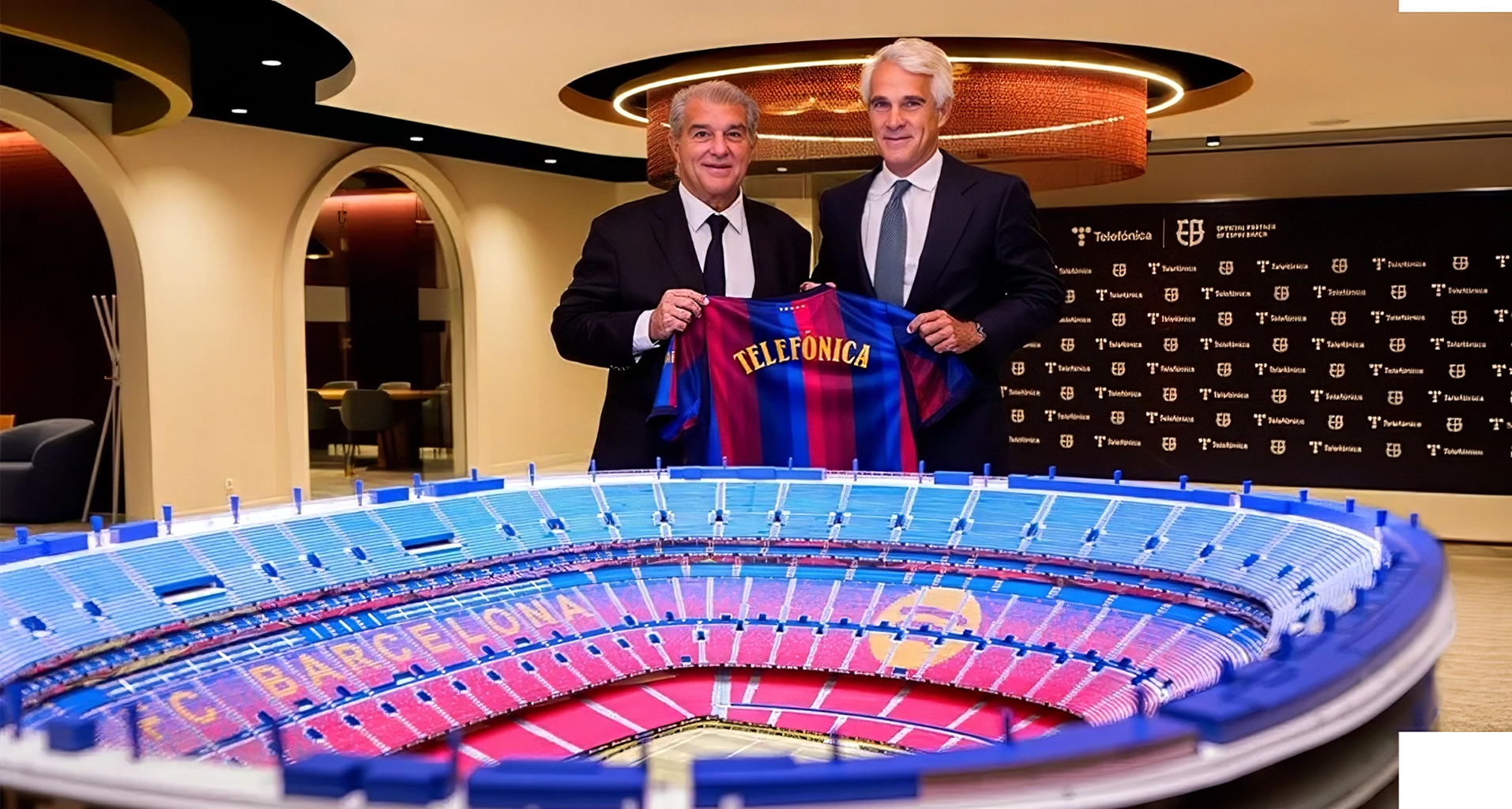
FC Barcelona announced Telefónica as an official partner of the Espai Barça project on 18 September under a five-year agreement. The deal grants the Spanish telecommunications group priority status for future technology projects at the site for the duration of the partnership, along with a private box and naming rights over a lounge space in the stadiums double ring, accessible from the private box level.
Espai Barça is the clubs redevelopment of its entire campus, covering Spotify Camp Nou, the Palau Blaugrana, Campus Barça and the surrounding retail and dining estate. The stadium is expected to reach a capacity of close to 105,000 once roof works are completed next year, which would make it the largest in European football. Club president Joan Laporta framed the agreement as advancing an increasingly connected and innovative Spotify Camp Nou. For Telefónica, it extends a concentrated run of investment in Spanish football: the group signed a sponsorship with the Spanish football federation in March 2026 running through the 2030 World Cup, which Spain will co-host. Telefónica España president Borja Ochoa described the partnership as a reaffirmation of the companys institutional role as a driver of the Spanish economy.
The commercially meaningful clause is not the hospitality inventory but the priority status for future technology projects. Barcelona has effectively sold a procurement pipeline rather than a logo placement. A conventional stadium sponsorship monetises attention; this monetises the clubs own capital expenditure decisions by pre-qualifying a supplier for work that has not yet been scoped. That converts a sponsorship into something closer to a framework vendor agreement with marketing attached, and it explains why a telecommunications operator with no need for stadium visibility in its home market would sign. The connectivity, network and in-venue technology deployed at a 105,000-seat stadium functions as a reference installation that Telefónica can sell to enterprise customers elsewhere, which values the partnership on a basis unrelated to broadcast exposure.
For clubs carrying heavy construction debt, this is a replicable structure: the build itself becomes sellable inventory, and suppliers pay for the right to be considered rather than being paid to deliver. It also raises a governance question that the industry has not yet confronted, because priority status narrows competitive procurement at precisely the moment a club most needs competitive pricing. Barcelonas financial position makes the trade understandable, but the precedent matters for any club financing a stadium against future commercial revenue. More broadly, the deal marks the point at which telecommunications groups stop buying football as an audience proposition and start buying it as a technology showcase, which is a different budget, a different buyer inside the company, and a different renewal logic.