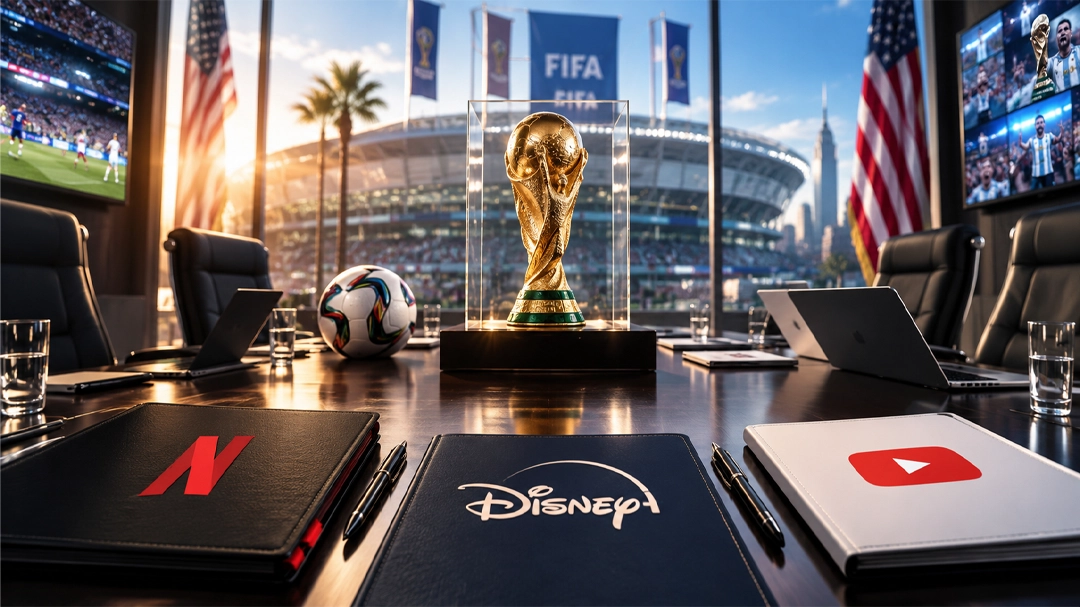
Netflix, Disney and Alphabets YouTube are preparing to bid for U.S. media rights to the 2030 and 2034 FIFA World Cups, positioning themselves as challengers to incumbent rights holder Fox. Preliminary talks with FIFA are expected to begin within the next three months.
Fox currently holds the English-language U.S. rights to the 2026 World Cup, acquired for $485 million, while Telemundo holds Spanish-language rights valued at about $600 million. For the 2030 and 2034 cycles, media executives are reportedly budgeting between $1.5 billion and $2 billion per tournament, a substantial increase driven partly by FIFAs indication that it intends to sell English- and Spanish-language U.S. rights together rather than separately. That structural change is likely to push the combined price higher still. Amazon and Apple are also said to be potential bidders. The 2030 tournament will be co-hosted primarily by Morocco, Portugal and Spain, while the 2034 edition is set for Saudi Arabia, meaning U.S. broadcasters will be selling coverage of tournaments played almost entirely in time zones that are unfavorable to U.S. prime-time audiences.
The interest from Netflix and YouTube in particular marks a turning point for World Cup rights, which have historically gone to traditional broadcast networks with the balance-sheet capacity to absorb nine-figure rights costs through advertising and affiliate-fee revenue. Streaming-first bidders value the World Cup differently: as a subscriber-acquisition and retention event capable of driving sign-ups within a compressed four-year cycle, and as evidence that reinforces a platforms positioning as a destination for major live events rather than only on-demand content. A win by either would confirm that the worlds largest sporting property is no longer the exclusive domain of legacy broadcast rights holders, a shift that has already played out in other major U.S. sports-rights cycles.
If FIFA succeeds in bundling English- and Spanish-language rights and drives the price toward the top of the reported range, it will set a new financial benchmark for global tournament rights heading into the next decade. It could also pressure other international federations, including those overseeing the Olympics and major continental football competitions, to reassess the value of their own U.S. rights packages. The process would also intensify competition between Fox, with its incumbent advantage, and deep-pocketed streaming challengers, a dynamic that has already reshaped rights markets in the NFL, NBA and MLB.