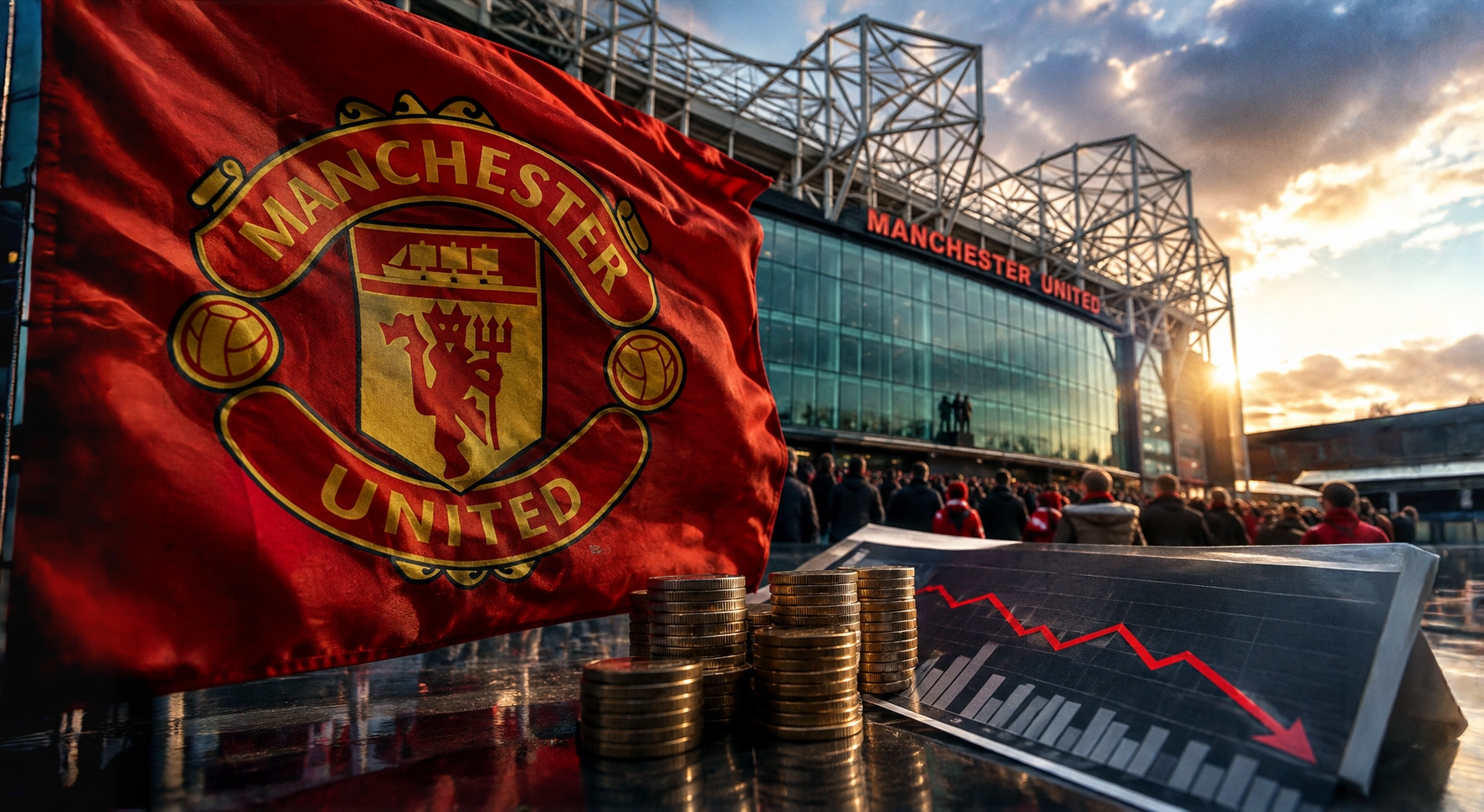
Manchester United reported record revenue of £677.6m for the financial year ended 30 June 2026, up 1.7 on the prior year, alongside a widened net loss of £43.0m against £33.0m in FY2025. Adjusted EBITDA rose 18.4 to £216.4m and the club posted an operating profit of £22.6m, reversing an £18.4m operating loss. The company guided to FY2027 revenue of £740m to £760m and adjusted EBITDA of £205m to £225m.
The composition of the revenue line is more informative than the headline figure. Broadcasting income rose 19.6 to £206.8m, while commercial revenue fell 4.8 to £317.3m and matchday revenue declined 4.2 to £153.5m. Growth therefore came from competition participation and central media distribution, the two lines the club controls least, while its two proprietary revenue engines contracted. On the balance sheet, non-current borrowings stood at $775.0m, equivalent to £577.6m, with current borrowings including accrued interest of £111.4m and cash down to £67.2m from £86.1m. Capital expenditure on property, plant and equipment reached £85.9m, of which £63.5m was land acquisition for the proposed new stadium. Chief executive Omar Berrada said the club had completed the major milestone of securing the land forming part of the proposed location.
The gap between an 18.4 rise in adjusted EBITDA and a deteriorating net loss is where the structural problem sits. Operationally the club is improving; the loss is driven below the operating line by financing costs, including adverse currency movement on dollar-denominated debt held by a sterling-earning business. That is a capital structure issue rather than a trading one, and it is not fixed by winning matches. With cash falling, a revolving facility drawn down, and a stadium programme that has so far consumed £63.5m on land alone before any construction, the club is approaching its largest capital commitment in decades with a weaker liquidity position than at any point in the current ownership era.
For investors, Manchester United functions as the sectors only continuously disclosed Big Five European asset, and the disclosure is unflattering. Record revenue coexisting with equity value destruction demonstrates that European football clubs can grow the top line without generating returns, because leveraged acquisition structures, squad amortisation and player-trading cycles absorb the operating surplus. Intangible investment of £143.7m, net of £148.6m in player sale proceeds, shows how much of the business is a rolling asset trade rather than a conventional operating enterprise.
The timing gives the numbers wider significance. US capital has moved aggressively into Premier League and continental assets over the past two years at valuations built on media growth and stadium-led uplift. United is the live case study in what that thesis looks like when the financing is denominated in the wrong currency and the stadium is still a land purchase. Every club now marketing a minority stake to institutional buyers will be read against this set of accounts, and lenders underwriting European football stadium projects have a new reference point for how quickly a record revenue year can still produce a larger loss.